

Lady Chatterley's printer
Between the sheets

An apology
In my thrilling newsletter about business rates, I confessed to being a Grumpy Small Business Owner Complaining About Tax, or GSBOCAT.
But a reader writes: “If you had said Angry Small Business Owner Complaining About Tax, you’d have been an ASBOCAT (which is arguably ALL cats).”
This Wag of the Week is quite right. All I can say is there will be an inquiry and future funnies will be referred to an appropriately constituted Puns Commission.
A quick update: the Fighting Fund now stands at £2,512. As a reminder, just use the code FIGHTINGFUND for 5% off all orders on our website until the end of January. We’ll add the profit from all of these orders to a kitty to invest in our website and therefore “future-proof” (yuck) Backstory against rising costs such as rent and rates.
In answer to a couple of FAQs:
We are totally agnostic as to whether local customers shop with us in-person only or prefer to “click and collect” by ordering online and then popping in to pick up their books. We love to see you in person however you like to do your shopping and remain entirely committed to our bookshop and bar. (The discount only applies if you click-and-collect, because the website is the part of the business that needs the most work.)
Thank you so much to a few of you who have offered to make donations to the fund, but we’re saying a very respectful ‘no thanks’. We are a business, very much a going concern and are very confident of remaining so. The idea behind the fund is to make Backstory even better and therefore less susceptible to future shocks in bills. We make enough profit from purchases to enable us to do that, which is why we’re encouraging more such purchases if you want to support this aim.
Come to an event
We have some amazing upcoming events at the bookshop, including sports writer Jonathan Wilson, Bryony Gordon, the historian Janina Ramirez and the authors of three of the best novels coming soon in paperback: Nussaibah Younis (Fundamentally), Jessica Stanley (Consider Yourself Kissed) and Nero Prize-winning Claire Lynch (A Family Matter, in conversation with Clare Chambers).
IN AN AGE WHERE READERS flock to buy the latest smut-on-ice (hello, Heated Rivalry fans) or queue up for beautifully produced hardback editions of dragon porn (sorry, ‘romantasy’), the fuss caused by the publication of Lady Chatterley’s Lover in 1961 is so incomprehensible as to seem not so much to hail from 65 years ago as from a different planet.
The, ahem, backstory to the publication remains as juicy and sexy as D. H. Lawrence’s book itself was reputed to be.
And one of Backstory’s regulars, Giles Rowe, recently offered me a dash of extra tea that I am, of course, delighted to spill.
In one of my newsletters last year, I celebrated the delightfully irreverent spirit (as well as commercial nous) of Allen Lane, the founder of Penguin.
One of the calls that established his reputation — and his fortune — was his decision to risk financial and reputational ruin by finally publishing an unexpurgated edition of Lady C.
As many of you will know, Lawrence wrote the naughty little thing in 1928 but it was so notoriously sweary and steamy (four-letter words being referenced and indeed enacted) that it had only ever been available to British readers in edited form.
Some enterprising souls smuggled in unexpurgated editions from Europe, but they were promptly dealt with by authorities concerned for the nation’s morals. Magistrates ordered the destruction of 17 such batches in the 1950s.
In 1959 Roy Jenkins, later a reforming Labour home secretary, managed to persuade Parliament to liberalise legislation on supposedly obscene publications, allowing those prosecuted to argue that publication served the public good. Lane had just the book to test the scope of the new law. It was Lady C’s moment.
As Jeremy Lewis relates in his highly readable biography of Lane, The Man Who Changed The Way We Read, Lane reckoned that “there’s a time in a publishing firm, especially when things are going well, when to chuck a jemmy in the works is a very good thing because it gives everyone a lift”.
And what a jemmy.
Lane faced many obvious hurdles: a press (then as now) rubbing its hands in censorious glee, coppers accustomed to burning hundreds of thousands of naughty books and magazines, and the fabulously named deputy director of prosecutions, Maurice Crump, who thought the book a “trashy novelette”.
As Lewis tells it, Crump objected not just to the sex but “to Lawrence’s failure to tell the reader about Connie Chatterley’s everyday life – ‘whether she rode, hunted, played tennis or golf … She is little more than a female body into whose acts of love-making we are invited to pry.’
“And the same could be said of her lover, the gamekeeper Mellors: how, Mr Crump wanted to know, ‘did he spend his time when not game-keeping? Did he visit the local? Read, smoke, garden, do good works?’
“Mr Crump was equally severe about Lawrence’s prose. ‘Not only is his characterization poor, but it is in places also inaccurate or ungrammatical.’ He was particularly incensed by the fact that ‘the necktie Chatterley was wearing on p. 14 is described as being ‘careful’.”
A less obvious hurdle facing Lane was finding a printer willing to take on the job. They would do so at considerable risk: booksellers were somewhat protected by the defence of “innocent dissemination” (we innocents!), but printers were as liable to prosecution as publishers and authors.
Even if undeterred by the law, a would-be printer would have to face down the more conservative among their own (often unionised) staff. As Lewis relates, one firm had originally agreed to print the book but “proceedings ground to a halt when a compositor complained to the Head Reader”. Call it cancel culture.
Step forward Backstory regular Giles Rowe’s father Anthony. Rowe senior was then in charge of Western Printing Services, a small printer on an industrial estate south of Bristol. Pitman, which owned the firm, was happy to take on printing Lady C, though not at the much bigger presses that bore its own name. Rowe, however, was game. As Giles tells me, “he risked everything on a matter of principle that nobody else would touch”.
Rowe, who would later in his career have an alarm installed by the security services after printing the proofs of The Satanic Verses, set to work. By the time the trial began, he had 200,000 copies of Lady C ready to distribute to bookshops.
And so Lady C would have her day in court.
Readers may recall that Penguin tried to marshal an amusingly broad array of authors in its defence. Aldous Huxley thought it “an essentially wholesome book” and T. S. Eliot reckoned its suppression would be “deplorable”. Evelyn Waugh, though, declared Lawrence an author of “very meagre gifts” who had produced a novel “dull, absurd in places and pretentious”. Enid Blyton refused even to read it, but informed Penguin that “my husband said NO at once”.
Leading the prosecution, Mervyn Griffith-Jones had a lot of fun quoting some of the choicer dialogue: “But you warmed her up, oh, you warmed her up, I can see that. Ha-ha! My blood in her! You set fire to her haystack all right!”
Somehow, he managed to keep a straight face to enquire: “Do you think any future generation reading that conversation would get anything approaching an accurate picture of the way in which Royal Academicians conducted their conversation?”
And yet, despite such magnificent QTWAINs, the gamble paid off. Lane, Rowe and Lady C went before the jury, and the jury sided with them. “It sold 3 million copies,” Giles goes on, “and my father kept his job.”
Lane went on to make a fortune; Penguin Random House is now the world’s biggest publishing company.
And as for Rowe, Giles shares an intriguing postscript.
It turns out Lane gave Giles’s father a remarkable book as a token of gratitude. “The book was a leather-bound copy of the first Penguin paperback edition” of Lady C, writes Giles.
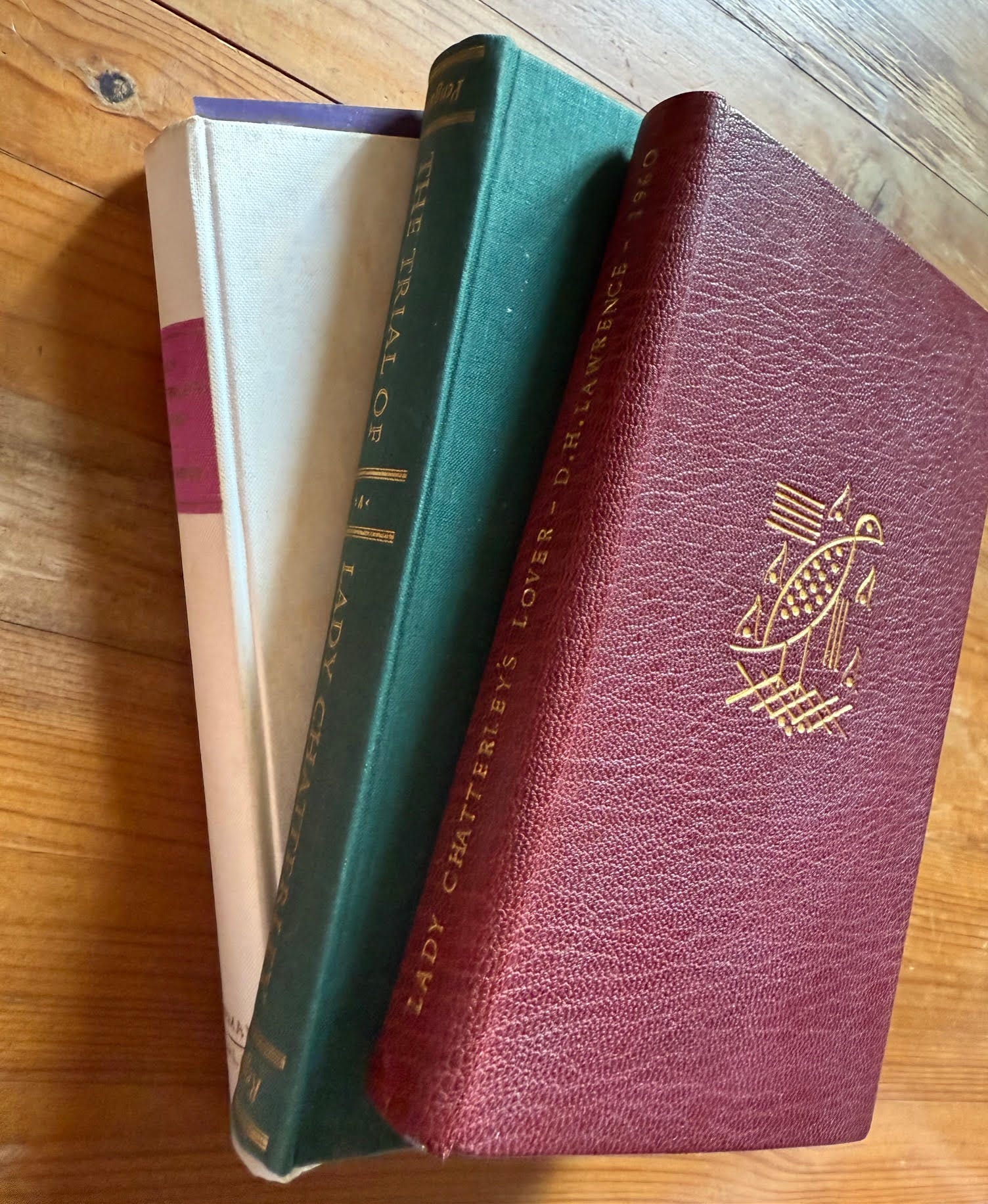
The young Giles soon suspected there was more to it than that, since his father would often show the book to his friends, much to their amusement, “but pointedly not to the kids”.
“My sister and I used to sneak into the living room and climb onto the back of an armchair, giggling furiously as we took it down. Then, almost hysterical with laughter, we fanned the golden edges of the pages to reveal an extraordinary sight.”
I will spare you the full details of this “extraordinary sight” over your Weetabix, but suffice to say that, when fanned, the edge of the pages feature a sequence of naked men and women enjoying more than just the pleasure of great literature. Between the couples, “two bunny rabbits copulate.”
Imagine a sort of analogue version of the White Lotus opening credits.
Of course, “spredges” – or sprayed edges – are now de rigeur on hardbacks, albeit without such concealed naughtiness.
But if Lawrence’s words were enough to cause such a stir, just imagine what Griffith-Jones, Crump or Enid Blyton’s husband might have made of Allen Lane’s gift, still pride of place six decades on, in Giles’s bookcase.
What a delightful story! Thank you Tom and Giles. And lovely to hear Bristol’s involvement in this great case. I wonder if Giles remembers a specific location for Lady C’s printing? I wonder what is there now?